Everyone contributed equally in the filming and planning process, Maddie wanted to use a unicorn for definite and it was me that put that into context. It was my idea to have the unicorn travel around the world to find its owner simple and suitable for children. I strongly wanted to use I-stop-motion to make the film as I thought that was what would look best and work best for our idea so that is what we ended up doing. During the filming process I was responsible for all of the backgrounds; I took some home and draw/painted on them to make them look the best they could as well as moving the objects whilst shooting. It was my idea to have Charlie (the unicorn) to be galloping and have the background slowly move across the screen as he gallops so it looks like he gallops from one onto the other so it flows rather than cutting from background to background. It was also my idea to have little features of each background moving to make it more interesting to watch and more than just two objects moving to make it more complex.
Monday, 31 October 2011

Marking criteria for production
Holding a shot steady where appropriate
We used stop motion so the flow of each shot is continuous as we had the camera held securely in a tripod.
Framing a shot including or excluding elements where appropriate
The tripod held the camera in place so we didn't require much handling or movement of the camera. In filming time there was a lead in the way of a few of our shots but as it is as dark as the background, we may crop that part out
Using a variety of shot distances where appropriate
This is something we didn't do because of stop motion. If we had extra time, perhaps the credits would have been shot as medium close ups so they were easier to read for our target audience.
Shooting material appropriate to the task set
We have achieved this. Our task was to create a childrens film, either PG or U. There is no foul language, violence or offensive images, you probably wouldn't find a Unicorn travelling the world to find its owner in a gory 18 film!
Selecting mise-en-scene
I think this we partly achieved this, the lighting was efficient, we drew all of our backgrounds of different settings (pyramids, a forest, a cloudy sky) and I drew the characters to fit the storyboard using colours that were bright and would be appealing to the target audience.
Editing so meaning is apparent to the viewer
We haven't started editing yet, but we will use our own knowledge of this and watch some more children's film clips (possibly stop motion) to gather ideas to make it apparent to children.
Using varied shot transitions and effects selectively and appropriately
We haven't done this either, but I don't think we will use a lot of transitions as they can be distracting and unnecessary. We will use transitions for the opening title and credits by looking up some on youtube for inspiration.
Using sound with images and editing appropriately
We have done no editing of our film, but we have allocated Maddie the narrative role for it. She will tell the story so the audience knows what is going on and will introduce the characters.
We have not thought about music for our film but children's films are often very lively and this is an adventure, there will be some element of sadness so this will be reflected in our soundtrack. We will do this by using Garage Band.
Using titles appropriately
The title will be at the beginning of the film and we may use some for the different backgrounds so the target audience gets a better sense of place. We will do this using Final Cut.
Contributions to the production process.
In our first filming lesson I looked up a unicorn outline on google images, drew it and then based the rest of our unicorns on that image.
I drew the background of the pyramids and brought in colouring pencils so the colour would be consistent and in case the pencils in the classroom were all being used.
During my spare time, I drew and coloured the characters, some of which can be seen in a previous post.
I drew:
Three unicorns
Four thought bubbles, including one of Charlie and his owner
The world
The owner himself
The words 'Where are you Charlie?' in bubble type writing.
I also was in control of taking the pictures for the stop motion, my pressing the space bar to take them and deleting any shots that had hands in.
Saturday, 29 October 2011
Progress report
The planning process so far hasn’t been incredibly difficult as long as we stuck to what the storyboard had said and what we had originally planned. Coming up with an idea was probably one of our biggest challenges and finding something realistic that was achievable in the time given to us, once we did have our idea it was easier from that point on. However the production process has been considerably more difficult than I first thought it was going to be, worrying about continuity and the shadows and light are the same time every time we shoot the sequence. This was one of our problems, having to film on different occasions and getting the conditions as similar to the original as we could possibly make it, the direction of light so the shadows are the same, the angle of the camera so the movements are smooth and the closeness of the shots to get the same proportions made it very difficult. However we used the same set up each time we filmed, the same tripod at the same level in the same position, the same lamp was used to produce the same amount of light to make it nearly the same each time, the only thing we could do in the circumstances. As our group chose to do I-stop-motion we get a little extra time to film as it is more time consuming than filming with actors, so as a result our plan after half time is to finish filming our sequence. Our number one priority is to finish filming, and then soundtracks and effects will be added after. I think we have chosen to have credits/titles at the end of our children’s film as then it doesn’t interfere with the sequence itself although given more time we would’ve liked to do them at the beginning in a way that links to film but again it would take too long in the time given.
Tuesday, 18 October 2011
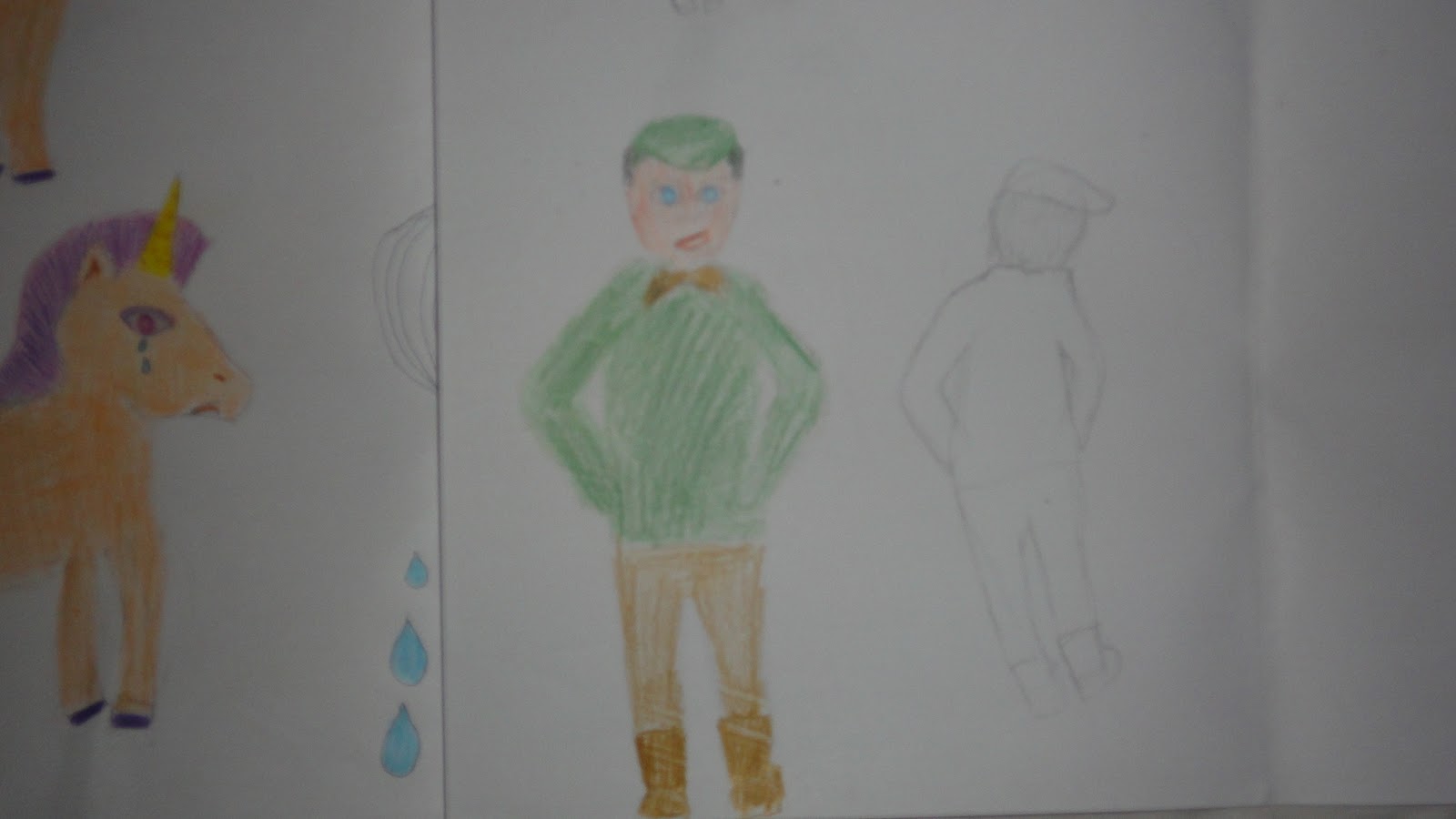
Some of the drawings I did at home in preparation for filming next lesson.
I drew three unicorns to represent him walking, tear drops that we are going to film as they form a waterfall that he walks through, his owner, Mister, a lightbulb to represent his sudden idea and a speech bubble showing him thinking about him and Mister.
I drew three unicorns to represent him walking, tear drops that we are going to film as they form a waterfall that he walks through, his owner, Mister, a lightbulb to represent his sudden idea and a speech bubble showing him thinking about him and Mister.



As part of the planning for our children’s film, we watched the opening sequence of the film, ‘Back to the Future’ and created a storyboard for it. A storyboard allows the director to film something the most appropriate and effective way and is a visual blueprint for the film, it also makes it easier to go back and redraft something.
We watched the sequence once and made notes on the types of shot, sound, duration, camera movement and possible themes and genre. We then drafted these notes into a storyboard in our groups, by drawing the key objects in the setting in each box at different parts of the sequences, made some notes on the storyboard about sound, duration and shot order. We used arrows to clarify the way the camera was moving and wrote what type of angle or shot used at that specific moment in the sequence. We did this because it will demonstrate to the examiner our knowledge of storyboarding, as we will have to create a storyboard for our children’s film sequence, which needs planning before filming.
The lesson before the storyboards was about film classification. We learnt that the BBFC (British Board of Film Classification) are responsible for the certification of films in Britain, so that they are suitable for the target audience.
We looked up the guidelines on the BBFC website (www.bbfc.co.uk) for U and PG films and each group were given either U or PG and we wrote on pieces of A4 the basic guidelines, to feedback to the class. Then we watched four sequences and had to guess in our groups what certificate they were and justify why we thought they were either U or PG. We watched Harry Potter and the Philosophers stone (PG), Up (U), Watership down (U) and Home Alone (PG).
It was important we knew the differences between a U and PG so that our film sequence would be suitable for our target audience of children and so we could give it the correct certificate.
Our opening sequence is going to be an animation, using stop motion, of a Unicorn visiting different parts of the world. The Unicorn is searching the world for his owner and is eventually reunited at the end of the film, if we were to create the whole film.
By watching the Milkmaid video by previous Long Road media students, we were inspired to do our own stop motion video. The Milkmaid video is about a maid who becomes a star, after having to look after a farm left by her father as her mother is too old and her brother is a baby.
They used characters drawn and coloured in by hand and had several cut outs of things like stars, letters and thought clouds. The music was relevant to the film as it was also about a milkmaid and set a happy mood because it was upbeat. During a sadder part of the film, such as when they sang about her father dying and her mother being too old, the music slowed down to reflect the mood.
Our group liked this style because the drawing doesn't have to be to a professional standard and therefore makes it easier for the target audience to understand.
Monday, 17 October 2011
write up of lessons
BBFC Lessons.
This lesson we learnt about what makes a film a U or a PG.
We started by going on http://www.bbfc.co.uk/ to define each one and find their similarities and differences. We were put into groups and each group had to make poster of the rules defining either a U film or a PG film. In this lesson I learnt that a U film should be suitable for ages 4 and under with no references to drugs, no discriminal language, mild bad language, only mild horror sequences if any, so basically it can be classed as a U if the content is mild enough for children under the age of 4. However in PG there is a little more lenience but not much it still has to be suitable for children. Then we watched the first 5 minutes of multiple films and had to decide if they were a U or a PG and say why we thought so.
The films we watched were:
Harry Potter philosopher’s stone which our group decided was a PG due to the violence,
The film UP we decided was a U as there was strong content but all very mild,
Watership down which we decided was a U.
Home alone we decided was a PG as there was violence and bad language but still suitable for children.
And Madagascar we decided was a PG as it was suitable for the viewing of children.
Storyboarding
We watched the first 5minutes of BACK TO THE FUTURE and were told to make notes of we were watching. For example the most important objects, the different shot types used in each shot or any significant change and the sounds as well as duration the shot was on screen for.
Using our notes we had to create a storyboard just like the one that would’ve been created before the actual film started being filmed. We had to show the camera movement and shot type and the duration of each frame to portray the frames we just saw on screen. This way you could see how the sequence was going to pan out, how similar it was to the film, this emphasised the use of a storyboard as it helped you imagine your outcome. It didn’t matter if you weren’t the best at drawing as you could make up for it in the info part of the storyboard.
BBFC
In our BBFC lesson we learnt what the differences were between U and PG films. We learnt from the bbfc website what is allowed in both cetificates of film. In U's no violece, drug scenes, bad language, horror, adult humour etc is allowed. Whereas in PG's (parental guidance) mild violence, thriller is allowed, within reason. However,still no swear words, sex/drug scenes are allowed, all forbidden.
(in lesson)
Harry potter - PG; contained some 'scary' scenes, mild violence.
up - U; contained no discrimination/drugs/horror/bad language/nudity/violence/sex
Watership down - U; classed as a U because it doesnt technically contain any of the above (in up) but has a creepy tone to the movie.
Home alone - PG; mild violence,bad language
madagascga - PG; slapstick humour, mild discrimination.
Subscribe to:
Posts (Atom)